Blanka Molnar
Acting reflections
A record of my acting lessons, collected by date.
10 reflections · In date order
Life Maps and Acting Practice
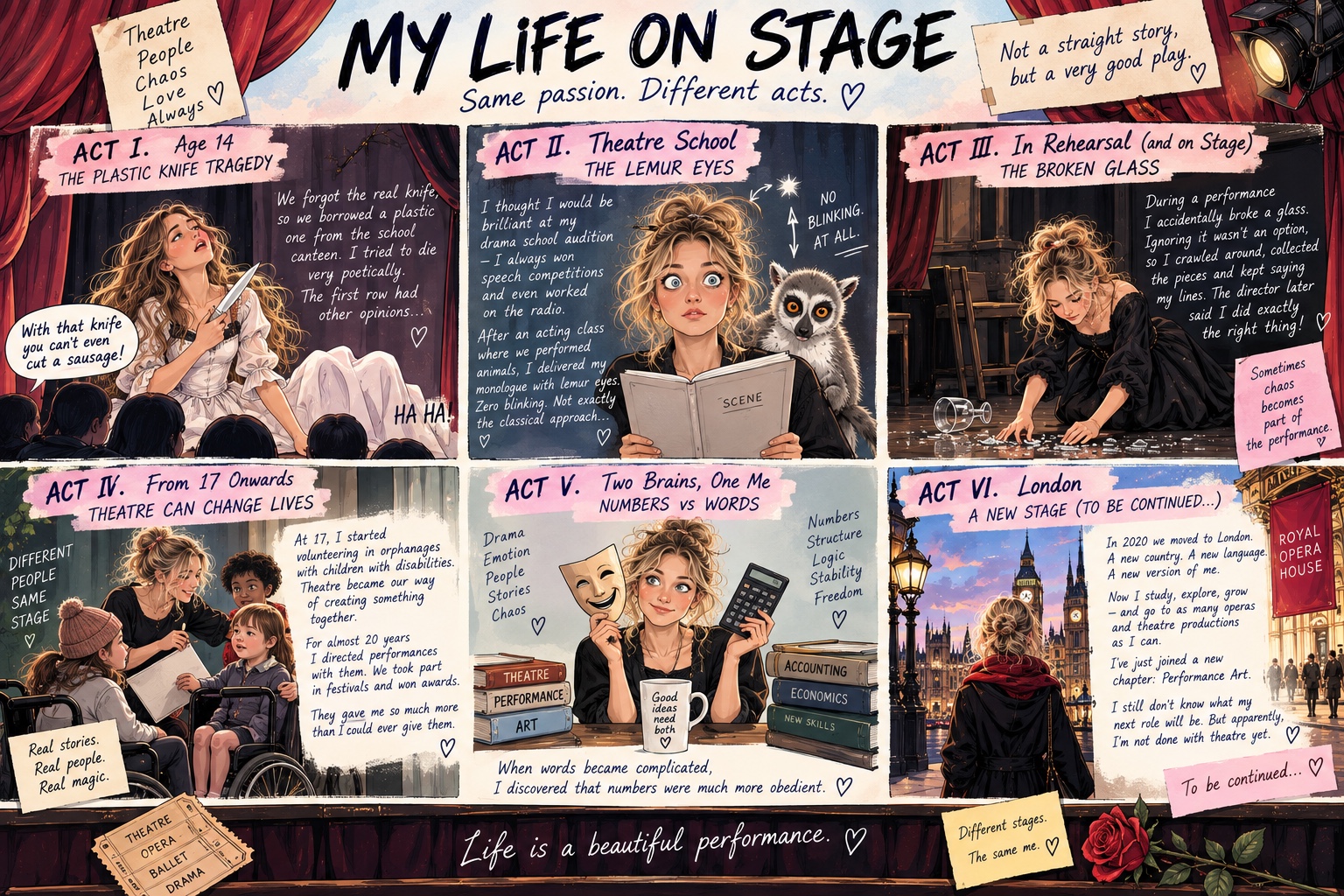
In the first half of the day, we each presented a life map. Rather than listing milestones such as when I was born or got married, I decided to share some of my theatrical mishaps: funny, slightly embarrassing moments from acting training and performing. There have been plenty over the years, so this was only a small selection! I thought these stories would be an interesting way to introduce myself. Everyone shared something different, and the presentations helped us get to know one another.
In the second half, we moved into practical acting work. We played a ball game and explored the space through walking, observation and exercises involving our circle of attention and imagination. We changed partners, worked in groups and created short improvised scenes, including a situation on the Tube. We explored actions and reactions, given circumstances, intentions, the “magic if” and inner monologue—using these ideas to shape how we behaved and responded within a scene.
My strongest realisation was how much I had missed acting and improvisation. I felt completely in my element. I enjoyed being on stage, creating something and responding to the people around me. The day reminded me how deeply I love this work. Returning to these exercises was a chance to reconnect with that part of myself, and I want to carry that enjoyment and willingness to play into the next lessons.
Acting Lesson: Focus Games and Given Circumstances
Today’s lesson began with a warm-up, followed by games for attention and concentration. First, we played the Ball Game with four different layers happening at the same time. We had to stay focused all the time: follow the ball, remember the sequence, move to another person’s place and stay aware of everything happening around us. At first it seemed quite easy, but as we became tired it was much harder to keep our concentration.
I enjoyed the next game, the Wush Game, even more. We passed an impulse and movement to each other: we could send it to the person next to us or across the circle, or reflect it back. At first, many of us were confused by the rules, but once we remembered the movements and words, the game completely changed. It became exciting and competitive in a playful way — everyone wanted it to become faster, louder and more energetic. It was great to watch the whole group gradually become involved.
My favourite part of these lessons, however, is the acting work. For our homework, we had to bring an everyday object and prepare a short piece showing an ordinary routine. I brought a towel and performed my routine after taking a shower. After the first performance, our teacher Blanka gave each of us new given circumstances, and we had to perform the same piece again in a completely different situation.
I found it fascinating to see how much the same simple scene could change when the circumstances changed. Sometimes something very ordinary suddenly became alive and interesting. Some of my classmates’ performances were especially enjoyable to watch. We laughed a lot, and I think the audience’s reaction is very important: if people laugh, feel something or respond emotionally, it means they are already taking part in what is happening on stage.
I really enjoy watching this process — how a simple exercise can gradually turn into real acting.
Acting Lesson: Intentions, Actions and Finding an Ending
I left today’s acting lesson with mixed feelings. I enjoyed taking part and watching my classmates, but I am not completely happy with my own work. I had a very bad headache and found it difficult to concentrate. Looking back at the exercises now, I feel there are things I could have done better.
We began with the short scenes we had prepared as homework, using four given lines to create a situation. It was interesting to see how differently everyone approached the task, and I really enjoyed some of the performances.
Next, we worked on intention: what I want and what I want from my partner. Sometimes we knew each other’s intentions, and sometimes we did not. One particularly unusual exercise allowed us to say only “yes” or “no”. My role was to put pressure on my partner and try to intimidate them, while saying only “yes”. It felt strange and quite funny to discover how the same word could take on a different meaning depending on the intention behind it.
After that, we each chose a verb describing an action from an actors’ dictionary. I would like to check the title of the book and the exact word I chose, but I understood the action as “to restrain” or “to stop”, and tried to hold back my partner’s reaction.
We then performed a short scene based on Stanislavski’s six questions, while continuing to work with our intentions: what I am trying to communicate to my partner and what I want from them. Instead of ordinary dialogue, we counted from one to ten, sharing a single sequence between us across the whole scene. Afterwards, the feedback was that our scene felt unfinished: we had not brought it to a clear end. Once we added an ending, I understood what had been missing from our first version. I had to leave the lesson a little early and would have liked more time to work on this. I really love working on these kinds of acting exercises and want to keep exploring them.
Although I am not entirely satisfied with my work today, I am glad this is a learning process where I can try things, make mistakes and recognise what needs to change. I can see what I need to work on, and I want to use that understanding to develop my acting skills.
Acting Lesson with Blanka: Tactics, Voice and Being in the Moment
Today’s acting lesson began with a warm-up involving chairs. There was one more chair than there were people. The leader’s task was to sit in the empty chair, while our task as a group was to prevent that for as long as possible. The leader moved at a set pace but sped up whenever they heard a sound. Without speaking, we had to work out who should get up and take the empty seat. Once someone had left their own chair, they could not return to it.
At first, it went badly. We tried blocking the leader and experimented with other ideas, but our tactics were wrong. Gradually, we realised that the best approach was to free a chair as far as possible from the one the leader was heading towards. Someone sitting far from that chair would move into it, so the leader would have to cross the room again. I enjoyed seeing how we began to understand one another without words and act together.
Next, we rehearsed our scenes using the dialogue we had been asked to learn. I particularly enjoyed breaking the text into sections and finding an intention for each one: what do I want from my partner at this point? As we watched the scenes, I caught myself thinking how much I love what we are doing. I love performing, watching others and being inspired by their work.
Elliot and Baykal’s scene, set in an office, stayed with me. I liked watching how they responded to each other and how they used their voices. They did not rely on force throughout: at times they whispered, and they changed their tone and volume. I especially enjoyed their verbal work and the way their voices helped shape the relationship between them.
Adina and Samuel’s scene felt wonderfully alive. They were so free and present in the moment that I stopped thinking of it as a performance. I was simply watching a story unfold. I saw another side of Adina. We had worked on a scene together before, and after the lesson I told him how exciting it was to see how different he could be.
For our next lesson, Yana and I need to explore our given circumstances and intentions more deeply, and add more layers so that what is happening becomes clearer. I want to go through the dialogue carefully again and divide it into sections: where does our mood shift, and where does one tactic fail so that we need to try another? We have already identified several tactics and realised that our characters want completely different things. I think that will help us make the scene more precise next time.
I have recently started reading a book by Katie Mitchell. I really like how closely she works with the text and the material before bringing it to an audience. I want to try applying that approach to our scene and read a little more before the next lesson. Right now, I am genuinely enjoying my time at college.
Further reflection — 4 October 2026
I am writing this reflection a few days after our acting lesson. I have kept thinking about the scene Yana and I performed, and gradually realised how differently it could be interpreted.
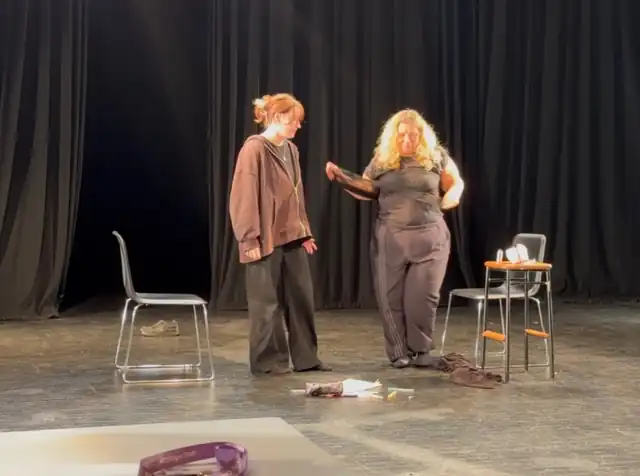
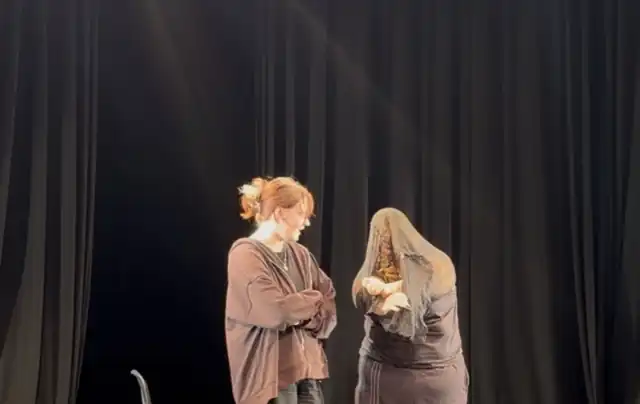
When we began rehearsing, the situation was very clear to us: I had put on Yana’s dress, which was too small for me. I did not want her to find out because I was worried about stretching it and knew she probably would not be pleased. Then I realised I could not take it off — I was stuck. For us, it was a funny situation involving a dress, and we had no other subtext in mind.
We rehearsed several times, but mainly practised the dialogue. It was only a few days after performing that I mentally looked at our scene from the audience’s point of view and realised that it could be understood very differently. In the scene, I took off my dressing gown to reveal that I was wearing Yana’s dress underneath. The meaning of this action seemed obvious to me, but now I understand that this particular action could have suggested another, sexually suggestive subtext that had not even occurred to me during rehearsals.
I feel ashamed and worried about this. It is especially embarrassing because I am already a mature student with experience, yet during rehearsals I did not notice that our scene could be interpreted in this way.
This was an important discovery for me: knowing the situation and rehearsing the text aloud is not enough. We need to rehearse the whole scene — with movement, gestures, pauses and interaction with our partner. We know what we mean, but the audience only sees what we show them. Even a single action can give a scene a meaning we never intended.
But I am glad that this was not the final performance. We still have the chance to make changes: to return to the scene, work through the awkward and embarrassing moments, and communicate more clearly what we wanted to show. I now understand better why rehearsals, feedback and an outside perspective matter. We probably cannot anticipate every audience reaction, but we should think about the different ways our material might be interpreted.
For me, this is also a personal lesson — not to be too proud or assume that my experience allows me to notice and understand everything in advance. I still have things to learn.
Acting with Blanka: Presence and Being Myself
We had a two-hour acting lesson with Blanka. We started with a warm-up and exercises to focus our attention and help us be here and now. The theme of the lesson was presence.
For me, presence means more than simply coming on stage and standing there. My thoughts, feelings and attention need to be there too. We worked on being ourselves and being fully present in what was happening.
I recently reread Stanislavski’s An Actor Prepares. I have also read his My Life in Art. During this lesson, I remembered the state he described as “I am”. For me, this means: I am fully here, now. I exist at the very centre of an imagined life, and it becomes real to me. I live within these circumstances, experience what is happening and let it pass through me. I feel that, with Blanka, we were exploring this principle in practice: how to be on stage with our whole being.
We had a very interesting task: to come on stage from the wings, say hello and leave. It sounds very simple, but I clearly remember my feelings before going on. When I am nervous, my accent becomes stronger, or I start forgetting English words. This time there was very little to say, but I still thought: what if I pronounce something incorrectly?
When I came on stage, I saw that my classmates accepted me. I relaxed a little and felt comfortable. I realised that, in general, I feel comfortable going on stage and performing. If only I did not worry so much about the language! But I hope my English will improve by the end of the year. I am working on it.
The most important part of this exercise was to keep that sense of presence while leaving. You have said hello, but the exercise is still continuing. As you leave the stage, you remain here and now, with your attention and feelings. This is an important thought for me: leaving is just as much a part of the action as entering and greeting people.
I really like the attention exercises where we gradually add several layers and have to keep track of them all at once. In this lesson, they were part of the warm-up, but I also think of them as a good workout for the brain. They keep us alert and make us fully participate in the lesson. If you are daydreaming, you cannot follow everything that is happening or take part in the exercise.
After this lesson, I felt again how important presence is. Being on stage means being there fully, noticing other people and what is happening around you, feeling and responding. And keeping that state throughout the whole action, including your exit.
Acting with Blanka: Living in the Scene and Being Myself
Today, in our acting lesson with Blanka, we continued working on our scenes. I remembered how much I had worried after our first performance, and I could see how much Yana and I have done since then.
We added a beginning, and for me this was probably the most important change. It gives a clearer reason for what happens next. We do not rush into the dialogue now. First, we take time to exist on stage, within the given circumstances. The audience can see that I have already put on someone else’s dress and am trying to hide it. The action is clearer now, with less room for the unintended interpretations that worried me so much after our first performance.
Working on the scene also feels easier because we know the lines and they have settled. Yana and I agreed on our next task, and Blanka supported us in this: to make the words part of the action, so that what we say and what we do belong together. I want us to live here and now within the given circumstances, with the text becoming a natural part of that life.
While performing our scene today, I remembered Stanislavski’s fourth wall, the imaginary wall between the actors and the audience. I felt it very clearly. It brought back memories of what I had read and of my own experience on stage. I was not interacting directly with the audience. My attention was inside the scene. I was present in the room where the action was happening, here and now.
I also really enjoyed our warm-up, a game with a witch. The witch was guarding our belongings, and we had to get them back. If she saw someone moving, she could freeze them, turning them into a stone. Only two classmates together could rescue that person by taking them beyond the edge of the playing area. One person could not do it alone. But if the witch caught them moving, she could freeze all three.
Unfortunately, we lost, but it was so much fun. Even when I could not move, it was interesting to watch the others trying to get the things back and rescue each other without being caught. There was something childlike about it, something playful and innocent. I think we all got carried away and became completely involved in the game. I love that feeling.
I feel that when we play, we become younger and allow ourselves to be ourselves. We stop pretending and thinking so much about how we look. We let go of the labels society gives us, and the ones we put on ourselves.
In those moments, I do not think, “I need to walk beautifully,” “I should pull my stomach in,” or “I should open my eyes wider so they look more expressive.” I do not think about any of that. I simply enjoy the process, as children do when they play.
It is wonderful to be myself like this. I am simply me, here and now, as I am. Without labels, without stereotypes, without something imposed on me.
Focus, Presence and Preparation for the Assessment
Focus, Presence and Preparation for the Assessment
We started today’s lesson with a warm-up designed to develop our concentration, attention and ability to react quickly to what was happening around us.
The exercise involved a series of seemingly meaningless movements and sounds, but everything had to happen in a particular order, maintaining a shared rhythm and tempo.
For example, in the Bunny Bunny game, we passed a signal from one person to another. The person receiving it had to respond with specific words and movements. At the same time, the two people standing on either side of them performed their own movements and said their own words. The rest of the group also maintained the rhythm.
This meant that each of us had three possible situations: receiving the signal ourselves, reacting when our neighbour received it, or participating as part of the wider group. Each situation required a different response.
I liked how the exercise demanded constant concentration. We could not simply stand and observe because the situation could change at any moment. We had to follow what was happening, maintain the rhythm and be ready to react immediately.
It was an excellent warm-up before working on our scene.
Rehearsing “The Secret”
After the warm-up, we started rehearsing our scene, The Secret, which we will perform for tomorrow’s assessment.
One of the most important things for me today was something Blanka said. She reminded us that if something goes wrong during a performance, whether we forget a line, make a mistake or something unexpected happens, we must not step out of character or stop existing in the given circumstances.
We must continue living on stage.
This immediately reminded me of Stanislavski and his principle of presence: “I am. I exist here and now.”
I think it is precisely in moments like these that we begin to understand what it really means to exist on stage rather than simply reproduce memorised movements and lines.
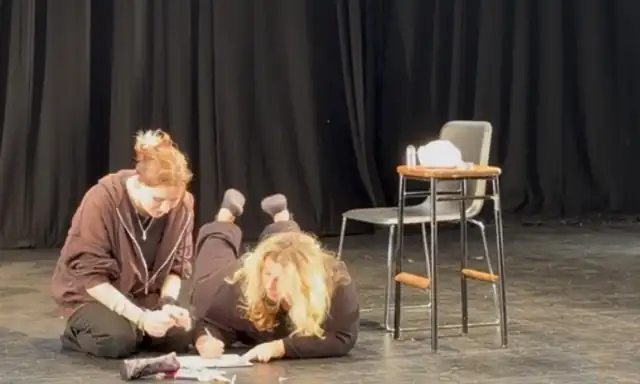
Today we experienced exactly this situation. During our scene, I accidentally made a hole in the paper. It was completely unplanned, but instead of stopping or pretending that nothing had happened, we incorporated the accident into the action.
It became a funny, spontaneous moment. I noticed that Blanka, who was our audience at that moment, was laughing.
This made me think about the audience’s reaction.
I believe that one of an actor’s most important tasks is to provoke some kind of response from the audience. It does not necessarily have to be the reaction we expected. The audience might laugh, feel surprised, sympathise, feel uncomfortable or even think that the actors are doing something wrong. But if they react, it means that something happening on stage has affected them.
Of course, a reaction alone does not guarantee that a performance has been successful. But for me, it is a sign that a connection has been created between the actor and the audience.
Tempo, Reactions and Natural Dialogue
Blanka also suggested that we perform the entire scene twice as fast.
I think the purpose was to make our dialogue more lively, natural and dynamic.
We already have a fairly good understanding of the given circumstances and our characters’ actions. However, we still need to work on the pace of our speech and, more importantly, the speed of our reactions to our partner’s words.
I realised that this depends directly on how well we know the text and how comfortable we feel within it.
When an actor is still thinking about which line comes next, it is difficult to truly listen to their partner. But when the words have become natural, we can stop simply delivering lines and start genuinely responding to what is happening here and now.
This is exactly what I want to work on tomorrow during our final hour of rehearsal before the assessment.
I would like us not simply to say all our lines correctly, but to truly live through the scene, maintaining a genuine connection with each other.
And if something goes wrong, we will improvise and continue existing in the given circumstances.
Let’s see how it goes tomorrow!
Acting Assessment: The Secret
Today we had our acting assessment. We performed scenes that we had been working on for the past two and a half weeks. All students were given the same script, with exactly the same dialogue, called The Secret. However, each pair had to create their own given circumstances, decide what their secret was, and develop their own story. As a result, although we all had the same text, every scene turned out completely differently.
Yana and I also created our own version of the story, which we developed over several lessons.
During rehearsals, we did quite a lot of work. First of all, we explored Stanislavski’s six fundamental questions: Who am I? Where am I? When is it happening? What am I doing? Why am I doing it? What do I want to achieve? Before we started rehearsing, we needed to find answers to these questions. This helped us understand our characters’ behaviour, movements, reactions and relationships.
We also paid particular attention to intention, the character’s inner objective, their “I want”. Each of us had our own objective, and these objectives were not always the same. I think understanding what each character wanted made our scene more meaningful and alive.
Finally, we worked with Stanislavski’s concept of the fourth wall, the imaginary wall separating the actors from the audience. This helped us exist naturally within the given circumstances without being distracted by the presence of spectators.
Today we performed our scene in front of an audience for the first time. Of course, it felt much more nerve-racking than performing during our usual rehearsals.
I cannot say that I am one hundred per cent satisfied with my performance. I think I could have made it a little brighter and more expressive, with more comedy. I also still have questions about my voice and vocal dynamics. How do I find the balance between speaking quietly or whispering while still being heard by the audience, and speaking emotionally without turning it into shouting? How can I control my volume and intonation while keeping my performance natural? I think I need to watch the recording of our performance to understand what worked and what could be improved.
I also feel that I did not fully develop the changing clothes moment. Perhaps I should have given it a little more time to allow the situation to unfold. However, one of my favourite moments happened during this part of the scene: I genuinely got tangled up in the dress, and Yana tried to help me get out of it. It felt very natural and, in my opinion, genuinely funny.
I also had an idea to hum or whistle a little tune during the scene. I decided to try it almost at the last moment, without rehearsing it beforehand. As a result, I feel that I did not fully develop the idea. Perhaps it could have added an interesting detail to my character if I had thought it through and rehearsed it properly. Or perhaps it was not necessary at all. This is another moment I would like to evaluate after watching the recording.
Despite all my self-criticism, I am very happy that we have the opportunity to perform on a real stage in front of an audience. For me, this is an incredibly valuable experience. Rehearsing and performing in front of people are completely different experiences, and I realise how important it is to learn to manage my nerves without losing my presence, connection with my scene partner, or the inner life of my character.
I hope that with every new performance I will feel more confident and free on stage. The next opportunity to test this will be in December. We shall see!
Discovering My Character: Connection, Isolation and Learning to Move On
Today, after a short warm-up, Blanka divided us into pairs and gave us dialogues to work on. I had spent the whole weekend wondering who my partner would be and which role I would get. I was particularly anxious about the possibility of working with Bianka. Her absences and lateness, especially when a partner depends on her, had made me worry. I understand that she may have reasons I do not know about, but it is important to me to feel that we can both rely on each other. So when we were paired together, my first reaction was uncertainty.
However, as we read, my feelings began to change. At first, I did not even immediately realise that the scene takes place in a prison. As we started working on the text, I felt how much I connected with my role. There is pain, fear and loneliness in it. It is material I want to explore through my own feelings and experiences, using them to understand the character.
My character is called Chess. She remains in prison, while Bianka plays her former cellmate, who was released less than a month ago. Her character has children, but she is not with them yet. I feel that there was a close friendship between these women, and I think Chess may have been in love with her. For now, this is my interpretation, which I would like to explore further in rehearsal.
One woman’s release has changed both their lives. They were used to living alongside each other, and now each has to learn how to exist differently. Habit has enormous power: even in difficult circumstances, another person can become your source of support. When that connection changes, both people can feel lost. One has remained in prison and the other has been released, but neither has yet found her place in this new reality.
For me, this scene is about the loneliness of isolation. Chess may have other cellmates, but that does not make her feel any less alone. Bianka’s character is now free, yet she is just as lonely. Their circumstances are different, but their pain connects them. I feel that Chess is happy to see her friend, while also realising that their old life together belongs to the past. They both need to learn how to move on, although neither yet knows how.
As we began reading together, I unexpectedly felt that Bianka might be better suited to this role than anyone else in our group. I began to understand Blanka’s choice. My initial anxiety gradually gave way to curiosity about what we could create together in this scene.
I like the fact that my character seeks refuge in music. We will be performing rap, which I have never done in my life. This is a completely new experience for me, and I am interested in trying it and discovering how rhythm and words can express my character’s state of mind.
I already have some initial ideas about her physical behaviour. I picture Chess in a prison jumpsuit. For some reason, a movement keeps coming to mind: she tries to fasten or unfasten a button. I do not yet know when this might happen or whether it will stay in the scene at all, but I sense her uncertainty in this gesture. She is waiting for the visit and is happy about it, yet she does not know how to behave around someone who used to be so close to her. I want to explore this movement and understand where it comes from.
Today, we also began analysing the material using Katie Mitchell’s approach, writing down the facts we already know and the questions we cannot yet answer. We drew on the extract, Blanka’s explanations and the information we had managed to find about the play. The music suggested by the author also became part of our introduction to the material. At the moment, we have more questions than answers, and I find that exciting. I want to discover these people gradually: why they speak the way they do, what they expect from each other, what they hide and what they fear.
I am going to read the whole play to understand the characters’ circumstances and relationships more fully. This scene has affected me deeply. It offers so much scope for acting and for exploring another person carefully through my own experiences and feelings. I want to understand Chess and find a way to convey her pain, her attachment and her attempt to move on.
Focus on the Partner
Today, after a short warm-up, we began with an exercise in attention and focus. We worked in pairs and named specific actions we noticed our partner making: “You smiled”, “You blinked”, “You moved your hand”. Our partner then had to acknowledge the observation: “Yes, I smiled”, “Yes, I blinked”.
At first, I did not fully understand the purpose of the exercise and felt a little awkward. When all the attention was on me, I wanted to find a way to draw it away from myself. But my experience changed when we began taking turns noticing each other’s actions and responding to the observations. Our attention started moving freely between us, and I felt much more at ease. I found it easier to interact with my partner than simply to be observed. I began thinking less about how I appeared and noticing the other person more.
The purpose of this exercise became clearer to me when we moved on to our dialogue. Blanka asked us to learn the text in small sections, three lines at a time, trying a different way of saying them with each repetition. We varied our intonation and explored different reactions and ways of interacting. I saw a connection with devising in this process: through experimentation and change, we explored how the scene could develop and what possibilities lay within the text.
I felt that I had already learnt my section quite well. But when Blanka came over to us, I became flustered and could not remember the words. She explained that this was exactly the difficulty today’s work was intended to address. During a performance, a phone might ring, someone might cough, or something unexpected might happen. If the text has only been learnt in one familiar way, any distraction can disrupt that pattern.
At that moment, it is important to bring my attention back to my partner. This was where I understood the connection with the first exercise: seeing the person in front of me again, noticing their gaze, movement or smile, and responding to what is happening between us. The words can then return through the interaction. It felt as though the text was beginning to connect not only with my memory of the words, but also with movement, emotion and my partner’s responses.
During the lesson, we learnt almost a whole page, and I really enjoyed this way of working. Repeating the text with variations helped me both to remember it and to discover something new within it. In future rehearsals, I want to hold on to this experience: when I feel lost, I can bring my attention back to my partner and to what is happening between us in that moment.