7 October 2026 — Animal Studies: Preparing for the Project
Today we began the lesson by moving through the space and changing direction. We moved sharply, changing direction on a clap. We then added shared impulses to our movement: we had to clap, jump and sit down together. We tried to sense the moment when the group was ready to act and respond to that impulse together.
After this, we moved on to creating a character through their walk. Blanka used Laban Effort to help us explore different movement qualities: a heavy or light step, direct or indirect movement, a quick or slow pace, and bound or free flow. Each quality offered two possibilities, and each of us chose our own combination.
As we continued walking, we answered questions about the character who was emerging: who they were, their name and age, where they lived and worked, what motivated them, what they feared and what they dreamed of. I found it interesting that my body responded first, and thought followed afterwards. The character gradually emerged from a physical impulse, from the walk itself.
My character was Bill, a builder from Texas. He was over fifty, he was lonely, and his greatest fear was losing his job. His colleagues were younger, and he knew that they could work faster. This made him even more anxious. At the same time, he had a big dream: to see the sea and dolphins.
Bill had a heavy walk and direct movements. He also seemed quite a straightforward person to me. His flow was sometimes bound, and his pace varied, although he usually moved slowly. Through his walk, I began to feel his age, his anxiety and his relationship with the world around him.
Then we came to my favourite part of the lesson: animal studies. Blanka asked each of us to choose an animal. At first, I wanted to be a panther. I love its grace, its physical fluidity and the way it moves through space. However, I realised that it would be physically difficult for me to recreate its movements at the moment, so I chose a turtle.
First, I put on socks. Then I had the idea of pulling my T-shirt over my head so that I could peek out and hide again, just as a turtle retreats into its shell when it senses danger. I really enjoy working on studies like this. At the same time, I thought how lucky the people who had chosen a rooster were: they could move on two legs instead of four! Next time, I might try a kangaroo, a monkey or another animal that can move on two legs. I would like to explore different possibilities.
The next stage of the exercise was new to me. We had to gradually transform the animal into a human, beginning with 80 per cent animal and 20 per cent human, then increasing the human proportion and reducing the animal proportion. I had never worked with this kind of transition before.
It was important to carry the animal’s way of looking and noticing its surroundings into the human body. We could communicate this through the position of the head, the gaze and our reactions. Even as I became more human, I continued to feel the turtle’s caution. The sense of danger stayed with me: I was always ready to retreat into my shell. I really enjoyed keeping that state alive and exploring how it could exist in a human body.
I think this work will be useful for our assessment project, which we will be creating in our devising lessons. Today’s exercise gave me a chance to feel how an animal’s movement and behaviour can become the foundation of a character, and I would like to continue exploring this.
13 October 2026 — Exploring the Story and First Ideas
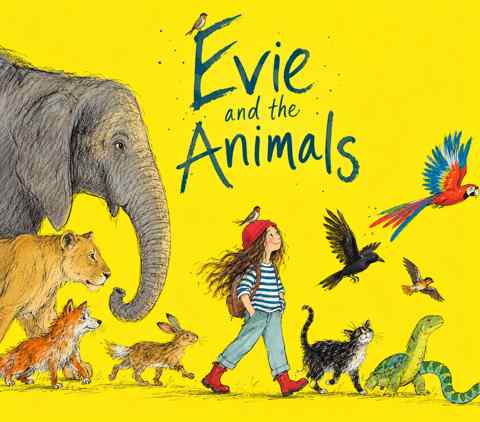
Today in our Devising lesson, we began discussing Evie and the Animals by Matt Haig, which we had been asked to read for homework. As not everyone had finished the book, we explored the plot, characters and main themes together.
Sarah suggested a song about how everyone is unique and special in their own way. I feel that this idea could become the central theme of our future performance.
For me, this story is primarily about accepting that being different is completely normal. Sometimes other people think you are strange, and sometimes you feel that way about yourself. But perhaps you are not strange at all. You are simply different, unique and special.
Evie is a young girl with an extraordinary gift, but this gift does not make her happy. On the contrary, she feels incredibly lonely. She struggles with friendships, does not understand her father, and her mother is no longer alive. I think this sense of loneliness and feeling different from everyone else is something particularly important to communicate on stage.
We began discussing how we might transform this story into a theatrical performance. I suggested an unusual approach: what if the human characters were represented by puppets, while the animals were played by actors? I think this contrast could be interesting, especially considering Evie’s special connection with animals. However, this is only one initial idea, and I am curious to see how it might develop.
Perhaps what excites me most at the moment is the devising process itself. We have a book, but no ready-made script, no established staging concept, and not even a clear idea of what the final performance will look like. We are starting almost from nothing, sharing ideas, discussing possibilities, experimenting and gradually creating something of our own.
I really enjoy this collaborative creative process, where nobody knows in advance what the final result will be. With each lesson, I become more and more interested in seeing how individual thoughts and suggestions gradually begin to take shape as a performance.
Tomorrow, during our Movement lesson with Blanka, we will continue exploring this story, and I am really looking forward to seeing where this creative process takes us.
14 October 2026 — Moving Together as an Ensemble
We began today’s Movement class with a warm-up, after which Blanka reminded us of Michael Chekhov’s Six Directions.
We explored these directions through movement and breathing. What I found particularly interesting was that, although we were almost standing still, the exercise required quite a lot of energy. I could feel my energy extending in different directions together with my breath. Even without travelling through space, there was a strong sense of movement throughout the body.
We then explored hand movements. One exercise involved imagining that we were waiters carrying trays, and later we used books and other objects. This helped us explore movement, attention and control over our bodies.
My favourite part of today’s class was working in pairs.
We moved together, trying to stay synchronised with our partners using peripheral vision rather than looking directly at each other.
I feel incredibly comfortable working with Layla. When I look at her, she somehow reminds me of myself when I was 18 or 19. I feel that we were quite similar at that age. Perhaps that is why I found it so easy to sense and read her movements. She, in turn, was very quick to pick up on my intentions and respond to them. There was a wonderfully natural sense of understanding each other without words.
We then started working in groups of four. There was no permanent leader. Anyone could initiate a new movement at any moment, and the others had to sense the change and follow. We tried not to look directly at one another, continuing to use our peripheral vision.
For me, the most important aspect of this exercise was the feeling of working collectively. We were not simply copying movements; we were constantly listening to one another through our bodies.
Gradually, we extended the exercise to the whole group. Now we had to keep every member of the group within our awareness, because anyone could become the leader at any moment. I really enjoyed that feeling of being focused on my own movement while remaining open to everything happening around me.
It reminded me of the focus and attention games we often play at the beginning of our classes as part of the warm-up. But today I could see much more clearly how these skills could develop into more complex ensemble work and how useful they might be for our future production of Evie and the Animals.
For me, ensemble work is not simply about moving in synchronisation. It is about sensing others, noticing the smallest changes, accepting someone else’s initiative and knowing when to offer your own.
After today’s class, I returned to Michael Chekhov’s writing and reread his ideas about directions of movement and the relationship between physical action and an actor’s inner experience.
As I was reading, I was reminded of one of the ideas behind his technique: we do not necessarily have to search for an emotion or feeling first and then express it through movement. We can begin with a physical action, an impulse, a direction of energy, and allow an inner sensation or emotional state to emerge through the movement itself. I feel that this is exactly what we were trying to explore today.
And once again, I find myself thinking how absolutely fascinating all of this is! All these acting techniques, the connections between them, the possibilities of the human body and imagination. As I read Chekhov, I remember things I studied years ago, discover things that are completely new to me, and suddenly begin to see familiar ideas from a different perspective.
Sometimes I experience an almost childlike sense of excitement: “Wow! This is amazing!”
I love that feeling. I get enormous pleasure not only from the classes themselves, but also from the opportunity to learn again, to explore, and to discover new dimensions of acting.
20 October 2026 — The Zoo Scene: Voices and Collaboration
Today in our Devising lesson, after a short warm up and a game, we began developing scenes. Sarah divided us into groups and gave us two scenes from Evie and the Animals. Our group worked on the zoo scene, in which Evie talks to an elephant.
We needed to find a way to show how Evie picks out a single voice from the many animal voices around her and enters into a conversation through thought. We wanted to convey the many voices of the zoo while making it clear to the audience which animal she was communicating with. This proved to be a challenging theatrical task.
However, the greatest difficulty for me today was working together within the group. Some suggestions were expressed very firmly, as though a decision had already been made, even when I disagreed. I found it difficult to balance standing up for my own idea with leaving space for the ideas of others. In collaborative work, it is important to me that everyone has the opportunity to speak and be heard. Today, I did not always feel that there was space for this.
I think learning to reach decisions together will be one of the main challenges of our project. I can usually work well in a team, but today I found it difficult. I want to learn to navigate these moments more calmly, explain my suggestions clearly and find a compromise that allows us to create the scene together.
It was very interesting to watch the other group’s work. They showed the scene in which Evie meets a dog. There were four performers on stage: two played the characters, while the other two voiced their thoughts. When Evie spoke aloud, the performer playing her spoke for herself.
I particularly enjoyed watching Elliot and Laila work together. Elliot played the dog, and Laila voiced its thoughts. They turned their heads in sync and looked in the same direction. This coordination made the voice and body feel like one character. At a certain point, I stopped noticing four separate performers and saw only two characters. For me, this was a very convincing theatrical way to represent a conversation through thought.
In our scene with the elephant, I felt that we needed a shared understanding of the conversation itself. I had the impression that not everyone was familiar with this episode in the book. I tried to explain the context, but I was told that it was not needed at that moment. I found this difficult to agree with, because understanding what the characters are talking about, and why, helps me find a way to bring the scene to life.
Our scene is still in development. At the next rehearsal, I would like us first to agree on what we want to communicate to the audience and then try out different suggestions in practice. Today’s lesson showed me that devising requires imagination, but also the ability to listen, experiment and make decisions together.
26 October 2026 — Script
The most challenging part of writing the script was deciding what to leave out. I read the book several times, selected the scenes and dialogues I felt were important, and then went through the script again and again, shortening and editing it.
I wanted to keep the main storyline, the characters’ personalities and the humour, while making the story suitable for the stage. It was difficult because even small conversations sometimes contain important details.
I still think the script needs to be shorter, but I have decided to keep this version for now. I believe the next step is to read it aloud with the other actors. This will help us understand which dialogues work well on stage, which parts are too long and what we can cut without losing the meaning of the story.
27 October 2026 — Initial Staging Ideas
After working on the script, I started thinking about how we could bring Evie and the Animals to life using as little scenery, costume and props as possible. I would love us to create the world of the play mainly through the actors, their movement, imagination and the way they work together.
My first idea is to have one actress playing Evie throughout the performance. Evie is in almost every scene, so I think it makes sense for her to remain the same person, while all the other actors change roles. Someone could play Evie’s dad in one scene, the headteacher in another, and an animal or even part of the scenery later on.
I imagine all the actors wearing the same basic costume: black trousers and a black long-sleeved top. To become another character, they would only need one or two recognisable accessories. Granny Flora, for example, could have a beret, glasses and a walking stick. Mrs Baxter could have a smart jacket or another distinctive item. A change of posture, walk or movement could help make the transformation clear. I would actually like these changes to happen in front of the audience rather than backstage.
I would also like to combine physical theatre with puppetry. Some animals could be played by actors using movement and a small costume detail, while others could be puppets or soft toys.
For Beak, the sparrow in the first scene, I found a workshop video showing how to make a bird puppet. I would love to try making something similar and experiment with the movement of its head, wings and body, so that it really seems to listen and respond to Evie.
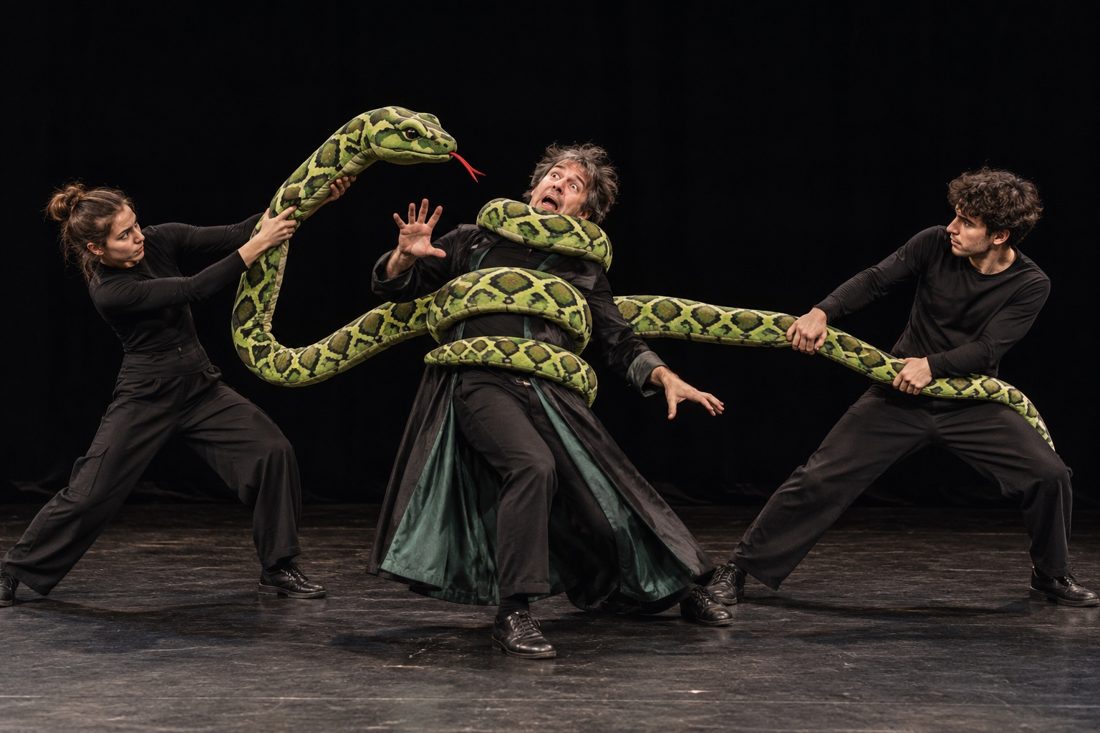
For Leaf, I found a large soft toy snake, almost three metres long. I imagine two actors operating it together: one controlling the head and speaking Leaf’s lines, and the other moving the body and tail. In the final scene, when Leaf turns against Mortimer, the actors could wrap the snake around him and move it in different directions, creating the impression that it is tightening around him. The actor playing Mortimer would also be part of creating this illusion through his movements. I think it could be quite dramatic without complicated special effects.
I would also like to try a small puppet or soft toy for Plato, Granny Flora’s bearded dragon. One actor could operate him and voice his thoughts. His movements could be very slow and precise, which might suit his mysterious character.
Another idea I particularly like is using actors themselves to create objects and scenery. For example, in the scene where Evie rescues Kahlo, one actor could play the rabbit, still dressed in black but with rabbit ears and perhaps white gloves to emphasise the movement of the paws. The other actors could form the cage with their bodies and arms. When Evie opens the cage, they gradually move apart and allow Kahlo to escape. I think this could create a much more interesting image than simply placing a real cage on stage.
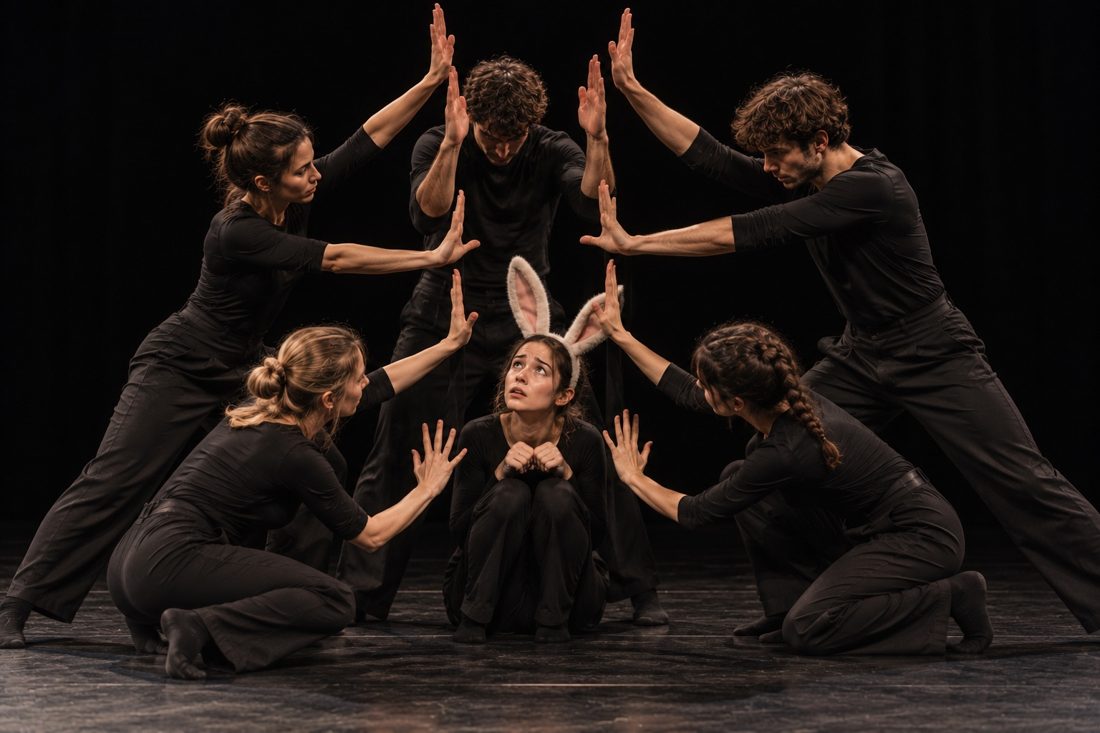
We could use the same approach for Dad’s car, school furniture, the lion enclosure and other locations. We would not need to build realistic sets if we could suggest them through bodies and movement.
What excites me most is the possibility of keeping the whole ensemble involved. In one scene an actor might be a person, in the next an animal, and later part of a car or a cage. I like the idea of the audience watching these transformations happen. Someone could take off Granny Flora’s glasses, put on rabbit ears and become Kahlo. Or a group of schoolchildren could turn into a piece of scenery together. Even actors with very few lines would still have an important part in the performance.
Of course, these are only my first ideas. I know some may be more difficult in practice than they seem now, and we might find better solutions together. I would really like to experiment with living scenery, animal puppets and quick character changes during rehearsals. I love the thought that we could create a whole world with just a few objects, our bodies, imagination and teamwork.